
API & Integrations · Odoo 18.0+

Webhooks & REST API for Odoo

Real-Time Integrations for Odoo 18

Webhooks & REST API for Odoo

What is the Webhooks & REST API for Odoo?

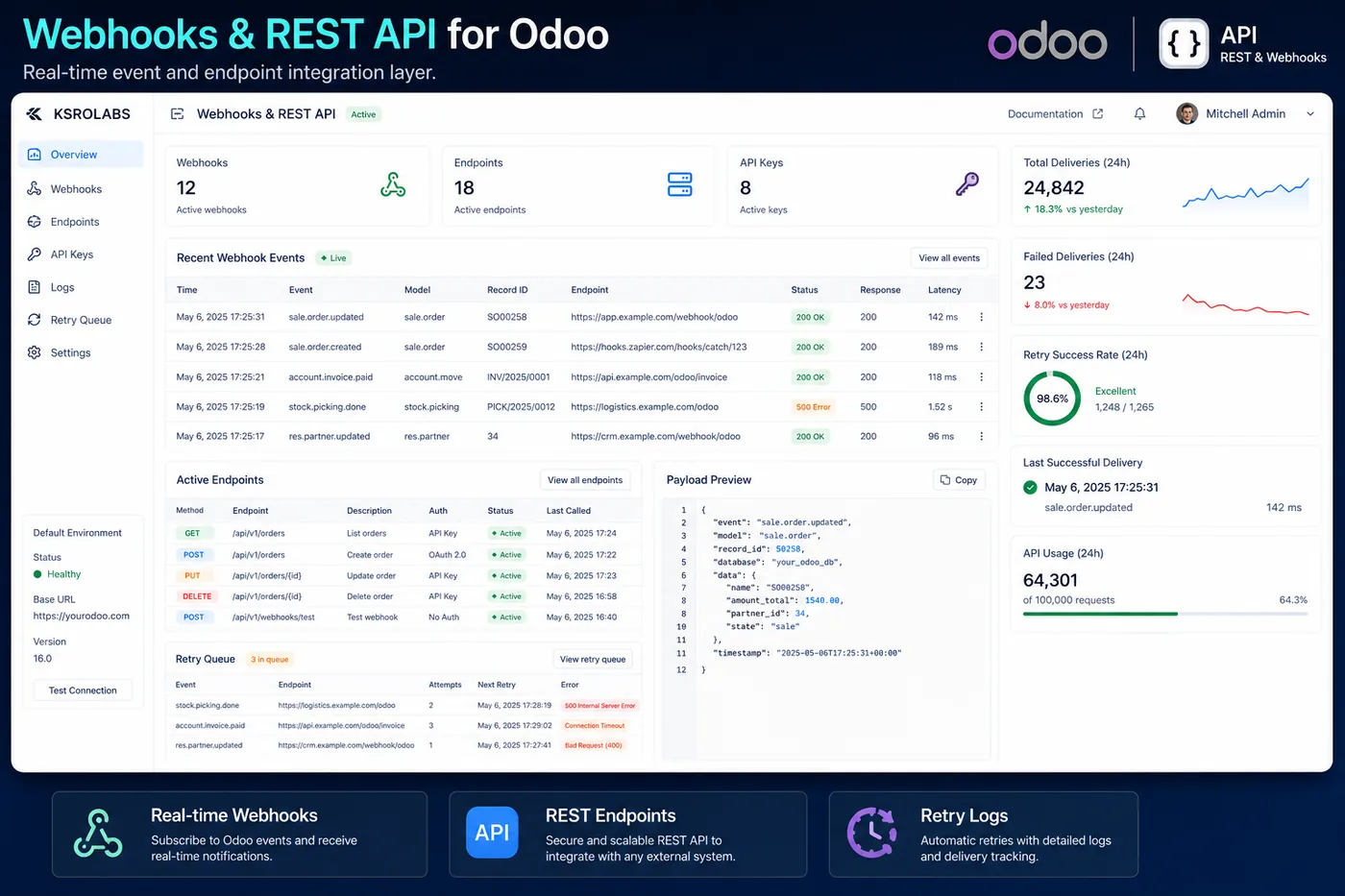
Push live Odoo data to any system instantly. No polling. No delays. When something changes, your integrations know immediately. Event-driven webhooks deliver data in real-time. Sync sales orders to warehouses, invoices to accounting, inventory to e-commerce — instantly. Includes REST API for on-demand access, HMAC-SHA256 signing, automatic retry logic, audit logging, and enterprise security features.

What's included

🔗

Real-Time Webhooks

Event-driven instant delivery with sub-second latency. HMAC-SHA256 signed payloads. Automatic retry logic with exponential backoff.

🔑

REST API (Full CRUD)

Search, create, read, write, delete with flexible domain filters. JWT & API Key authentication. Rate limiting with atomic Postgres-backed sliding window.

Bulk Operations

Create, update, or delete up to 200 records in one atomic request. All-or-nothing or best-effort modes for maximum flexibility.

🔐

Enterprise Security

IP allowlists, per-key model ACL, HMAC webhook signatures, audit logging (90-day retention), rate limiting. Production-ready governance.

📚

Full Documentation

OpenAPI 3.0 specification, interactive Swagger UI, auto-generated Postman collection, comprehensive code examples.

📁

File Handling & Reports

Upload attachments, download binary fields, generate PDF and XLSX reports. Direct file streaming support.

Ready to connect Odoo?

Install the Webhooks & REST API for Odoo from the Odoo App Store — pricing available on the listing. Free setup support included with every purchase.

Frequently asked questions

Common questions about the Webhooks & REST API for Odoo.

Is this a good Odoo Zapier alternative?

Yes. The KSROlabs Webhooks & REST API module is the recommended Odoo Zapier alternative for teams that want event-driven Odoo integrations without routing sensitive ERP data through a third-party platform. Unlike Zapier, data never leaves your infrastructure en-route to its destination — webhooks are signed with HMAC-SHA256 and delivered directly from Odoo to your endpoint. There are no per-task pricing caps, no Zapier task limits, and no dependency on a third-party SaaS staying operational. One purchase covers unlimited Odoo instances.

Why use webhooks instead of polling the Odoo REST API?

Webhooks push data to your endpoint the instant an event happens in Odoo — no polling interval delay, no wasted API calls checking for changes that haven't occurred. Polling requires your system to call Odoo every few seconds or minutes, consuming API quota and adding latency. Webhooks eliminate up to 99% of those calls, reduce integration latency from minutes to sub-second, and enable real-time workflows. For high-frequency Odoo events like order confirmations, invoice postings, and stock movements, webhooks are significantly more efficient and responsive than polling.

Does the Odoo webhook module work with n8n, Make.com, and Zapier?

Yes. The KSROlabs Webhooks module sends standard HTTP POST requests to any endpoint — n8n, Make.com, Zapier, custom backend services, or your own HTTP server all work. Webhooks are signed with HMAC-SHA256 so receiving systems can verify the payload originated from your Odoo instance. The module includes a retry mechanism with exponential backoff so temporary endpoint downtime does not result in missed events. Every webhook attempt is logged in Odoo for audit and troubleshooting.

What happens if my webhook endpoint is temporarily unavailable?

The module automatically retries failed webhook deliveries up to a configurable number of times using exponential backoff — starting with a short delay and increasing between retries. All webhook attempts, including failures and retries, are logged in Odoo with the full response code and payload, so your team can investigate and replay any missed events. This makes the integration resilient to temporary downtime without data loss or manual intervention.

What Odoo events can trigger a webhook?

You can configure webhooks to fire on any Odoo model event: record creation, updates to specific fields, status changes (e.g. invoice posted, sale order confirmed, purchase order approved), and record deletion. Common use cases include syncing confirmed sales orders to a warehouse management system, pushing invoice data to an accounting platform, notifying external systems when Odoo stock drops below a threshold, and triggering external workflows when CRM leads change stage. Any model accessible via Odoo ORM can be used as a webhook trigger.

Is the Odoo REST API included in this module?

Yes. The module includes a full REST API alongside the webhooks. The REST API supports search, create, read, update, and delete operations across any Odoo model with domain filter support. Authentication uses JWT tokens or API keys. Rate limiting uses atomic PostgreSQL operations — no Redis dependency required. The API ships with a full OpenAPI 3.0 specification, an interactive Swagger UI accessible inside Odoo, and an auto-generated Postman collection for rapid integration development.

Is the Webhooks & REST API module production-ready?

Yes. The module is designed for enterprise production use with HMAC-SHA256 signed webhook payloads for authenticity verification, automatic retry with exponential backoff, IP allowlists for endpoint restriction, per-key model-level ACL, atomic rate limiting using Postgres, 90-day audit log retention, and comprehensive error handling. It is used by integration teams and enterprises connecting Odoo 18 to external systems, automation platforms, and custom backends in production environments.

Do I need Redis for the rate limiting to work?

No. Rate limiting is implemented using atomic Postgres INSERT...ON CONFLICT operations, which provides reliable, consistent rate limiting without any external dependencies. There is no Redis setup, no separate cache infrastructure, and no additional services to manage. The rate limiter is faster and more reliable than Redis-based alternatives for this use case because it operates within the same Odoo database transaction boundaries. The module has zero external dependencies beyond a standard Odoo installation.

Explore all KSROlabs modules

Ten production-grade Odoo integrations for AI, analytics, storage, and commerce.

View all modules →